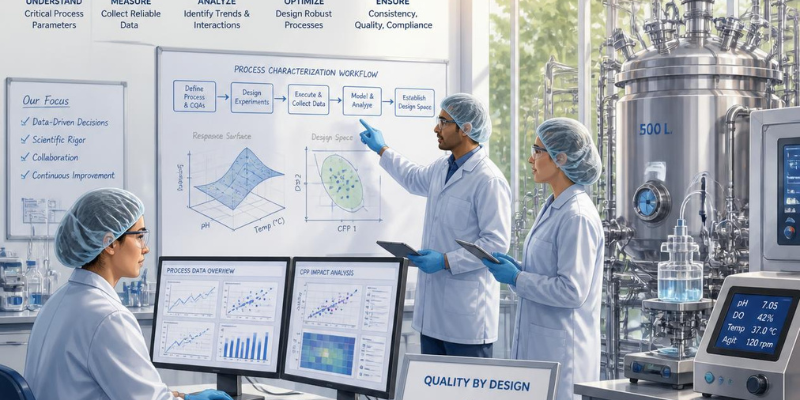
Process Charactertization in Pharma Industry
Process Charactertization is different than proving your process works. But proving you understand WHY it works.
And there is a disciplined, statistical way to do this that most teams ignore.
I have reviewed Process Characterization (PC) protocols & found a pattern.
– Run Design of Experiments (DoE) without clear objectives.
– Test parameters that “feel” critical based on group consensus
– Set acceptance criteria that are tighter than necessary (because “safer”)
Result is clear:
– Mfg. flexibility gets strangled
– Deviations that nobody knows how to address
– Delayed Time to Market
Solution:
The Goal of Process Characterization is to build a predictive model of how your process behaves.
1. Using data to drive risk assessments (not opinions)
2. Focus experimental effort where it matters – Spiking studies, Right CQAs, etc.
3. Qualify your scale-down models properly – Does it stay predictive when you vary process parameters.
4. Design experiments for statistical power – One-Factor-At-A-Time (OFAT) experiments require more runs AND have lower statistical power than a properly designed DoE.
For 5 process parameters:
- OFAT: 15 runs, 28% power to detect main effects
- DoE (Definitive Screening Design): 13 runs, 80%+ power to detect main effects AND interactions.
- And DoE detects interaction effects. OFAT doesn’t.
- In fermentation or chromatography, interactions between parameters are the rule, not the exception.
5. Set control strategies based on patient risk, not intermediate specs
Most teams set Proven Acceptable Ranges (PARs) for each unit operation independently.
But manufacturing is a chain.
One unit operation can compensate for variation in another.
Integrated Process Modeling (IPM) connects all unit operations into one predictive framework.
Instead of asking: “Is this parameter within its PAR?”
Ask: “What’s the probability this parameter setting causes an Out-of-Specification (OOS) result at drug substance?”
This gives you:
Tighter control where it matters (patient safety)
Wider operating ranges where it doesn’t (manufacturing flexibility)
Note: Process Characterization is a knowledge-building exercise (a model that predicts how their process behaves).
Read also:
- HVAC Qualification Process
- Pharmaceutical Process Validation: A Lifecycle Approach
- QbD Fundamentals for Pharmaceutical Development
Resource Person: Saket Yeotikar


